
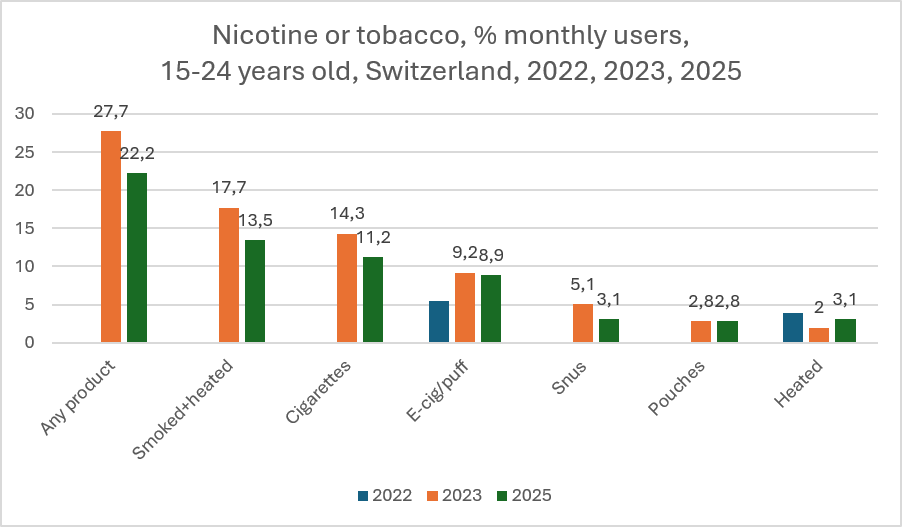
Good news on the smoking front, which remains one of the leading causes of illness and death in Switzerland. The latest data from the Health and Lifestyle Survey, published on September 22, show that among young people aged 15 to 24, the proportion of smokers and users of tobacco or nicotine decreased between 2023 and 2025. In this age group, the proportion of monthly smokers was only 13.5% in 2025, down from 17.7% in 2023, a relative decrease of 24%. Among 15 to 24-year-olds, the proportions of monthly users of e-cigarettes (9%) and nicotine pouches (3%) remained stable, and the proportion of users of oral tobacco (snus) decreased from 5% to 3% over this period. However, among adults over the age of 24, the proportion of users of various tobacco or nicotine-containing products remained virtually unchanged between 2023 and 2025 (the data for 2022 are not reported in a comparable way, in particular the % of monthly users is not always reported).
These figures are quite reassuring: consumption is declining for combustible products, which are the most dangerous, and remains stable or is decreasing for non-combustible products (e-cigarettes, pouches, snus). Consequently, these figures do not support the view, often reported in the media and in debates on this topic, that the use of new nicotine products is on the rise among young people.
This decline in the prevalence of smoked tobacco use cannot be explained primarily by the replacement of cigarettes with new non-combustible products (e-cigarettes, pouches, snus), as consumption of these other products remains stable or is declining. Nor do the data support the hypothesis often raised in debates on this topic, that non-combustible products encourage young people to start using combustible products (the gateway theory). If that were the case, we would have observed an increase in the prevalence of cigarette use following the rise in the use of e-cigarettes and puffs in the years leading up to 2023.
This decline in prevalence is a remarkable achievement in a country that lags considerably behind its neighbors in terms of tobacco control policies and is heavily influenced by the tobacco industry. In fact, Switzerland ranks second to last out of 37 European countries on the Tobacco Control Scale, which ranks countries based on their tobacco control policies (taxation, smoke-free areas, restrictions on advertising and sponsorship, health warnings, addiction treatment, etc.). Furthermore, Switzerland ranks 96th out of 98 countries on the Global Tobacco Industry Interference Index, which ranks countries based on the degree of influence exerted by the tobacco industry. This poor ranking is likely because Switzerland is home to the international headquarters of major “Big Tobacco” companies such as PMI, JTI, and BAT.
It is true that a new federal law on tobacco products went into effect in October 2024. It introduced new measures, such as a ban on sales to minors (although such bans already existed in several cantons) and new regulations regarding non-combustible products. However, there are gaps in the implementation of these measures, and enforcement is insufficient. Consequently, this law does not explain the observed trend in smoking prevalence among young people.
If the substantial change (a decline of about one quarter) observed among young Swiss people between 2023 and 2025 is due neither to the replacement of combustible products with non-combustible ones nor to an effective policy, then what is the cause? In the absence of a recent, in-depth study on this topic, we can only formulate hypotheses, notably that of a more general shift in the behavior of young people, who go out less often, drink less alcohol, and spend more time alone at home. If you have a better explanation, please share it using the comments.
And please take a look at our Stop2Smoke,net website here.
This is very promising especially coming from Switzerland.
The Swiss win THR again. Let’s do that.